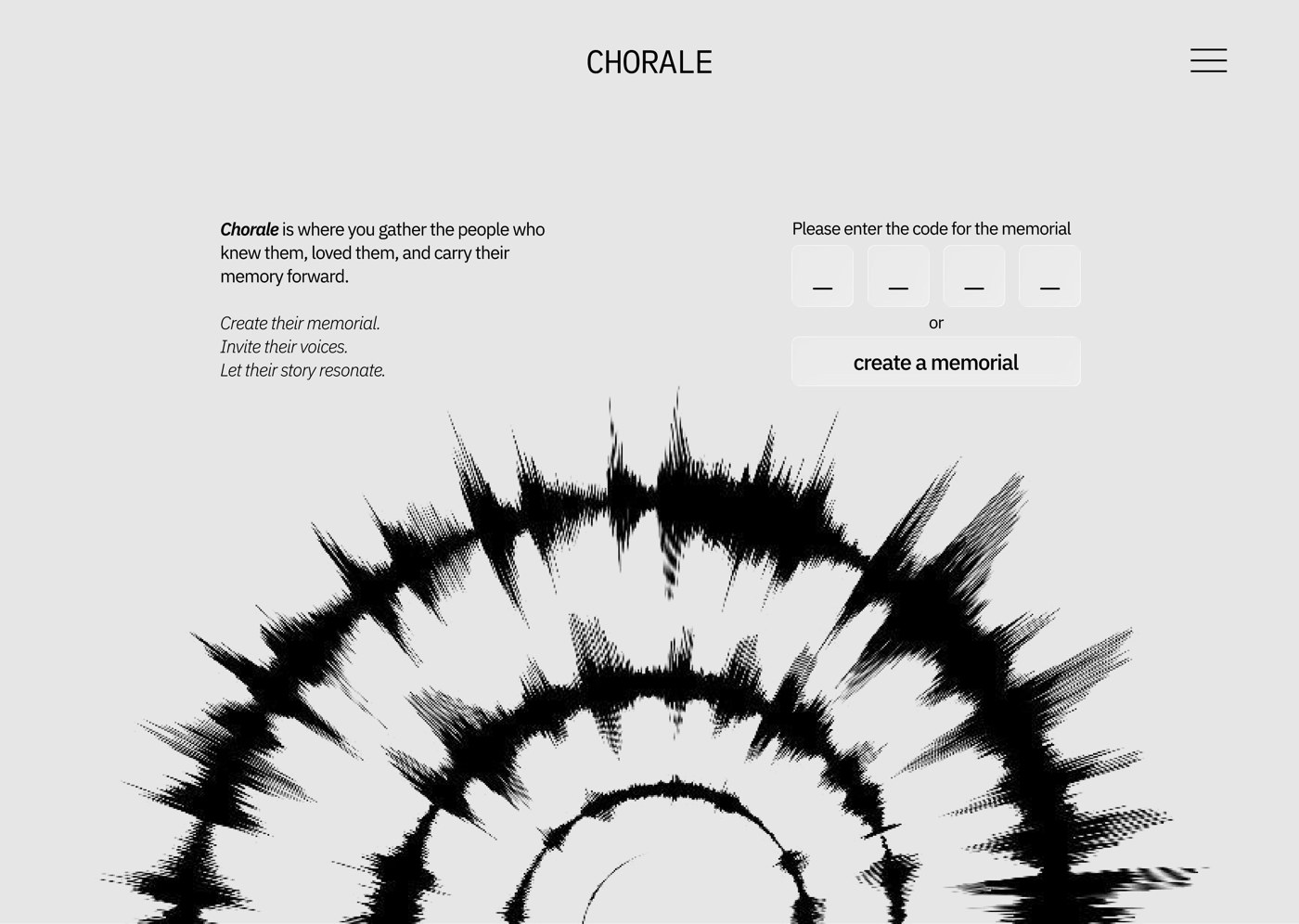
Move over the spiral: each fragment is one contribution. The rest steps back, as in the prototype.

At a glance

Problem

Grief moves online through tools built for archives, likes and AI simulation.

Approach

A participatory memorial where absence is kept as structure: a growing sound spiral shaped by contributions, not algorithms.

Evidence

A survey of 82 people found 57% uncomfortable with AI simulating someone they lost. The prototype was tested with 6 participants.

Hover the spiral and one memory steps forward while the rest falls back to grey. Open it to read what someone left.

Overview

A participatory digital memorial built on one premise: absence should be preserved, not filled.

Where other platforms simulate the deceased through avatars and chatbots, Chorale chooses restraint: memory builds up through contribution, witnessing and silence, as a sound spiral shaped by its community.

The problem

Mourning has moved online, onto tools never built for grief: archives that freeze a profile, feeds that give loss a like count, and AI that offers to simulate the person you lost. That last idea was the one people rejected hardest, and it became the starting point.

Research question How can interaction design support collective digital remembrance without simulating the deceased, while preserving absence as a structural condition of the system?

Continuing Bonds theory framed the answer: a bond can continue as connection rather than closure. Working as research through design, the interface became the way the question was explored.

Research

A literature review, then an exploratory survey of 82 people in Turkish and English. Each finding shaped a decision:

FindingAllWhat it changed
Uncomfortable with a simulation of someone they lost (16% comfortable)57%No AI simulation, anywhere
Want to talk to the deceased directly5%Contributions are offered, never answered
Keep a memory alive by talking about the person with others61%Memory as a shared, growing whole: the spiral
Want a mix of private and shared space48%Visibility per memory, plus private Quiet Notes
Prefer passive viewing as a way of taking part57%Observer is a full role, not a lesser one
Unsure whether a platform should reflect cultural or religious traditions51%No predefined rituals

Exploratory survey, 82 participants, both language versions combined. Source: thesis, chapter 6.3.2.
Why sound

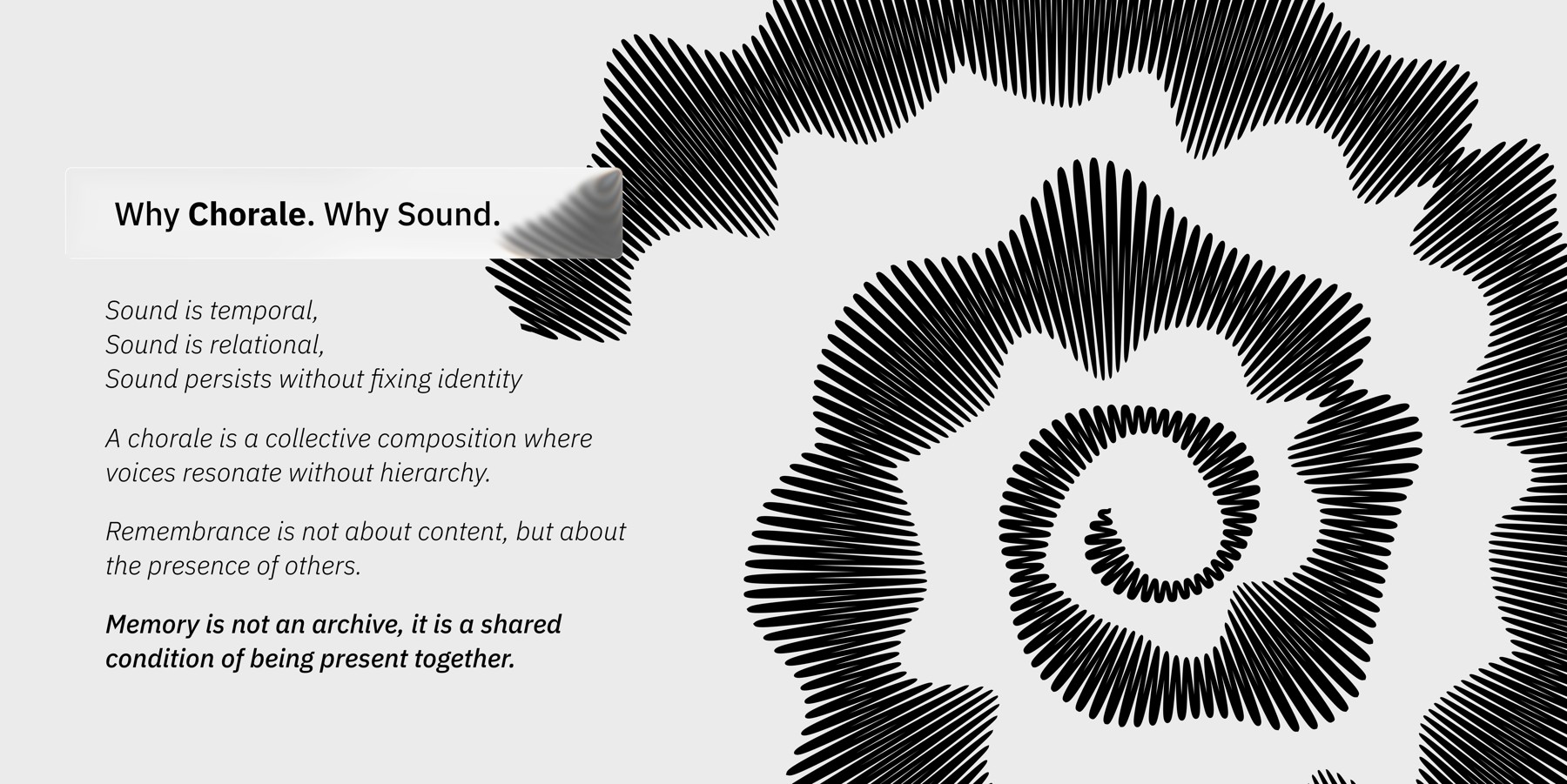
Sound is temporal.
Sound is relational.
Sound persists without fixing identity.

Sound builds a whole out of fragments and never fully disappears; it disperses. A person's memory behaves the same way, which is why sound became the medium. A chorale, a piece sung by many voices without a lead, gave the project its name.

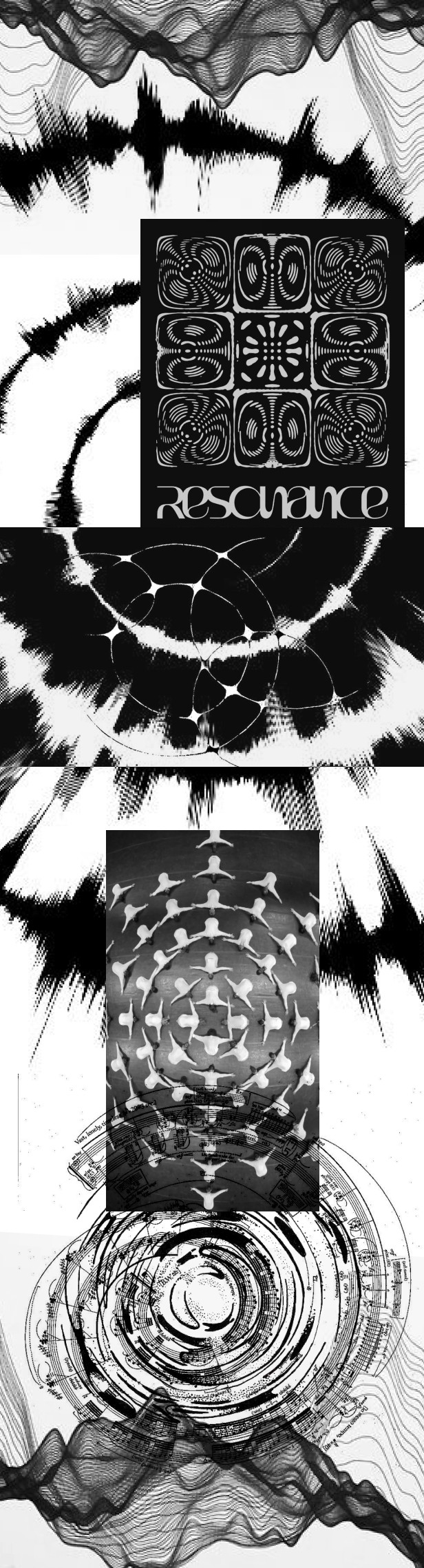
Why Chorale, why sound: concept slide describing sound as temporal, relational and identity-resistant Chorale moodboard: waveforms, spirals and resonance patterns translated from sound into visual form
Concept slide and moodboard: sound as material, before it became the interface.

Finding the form

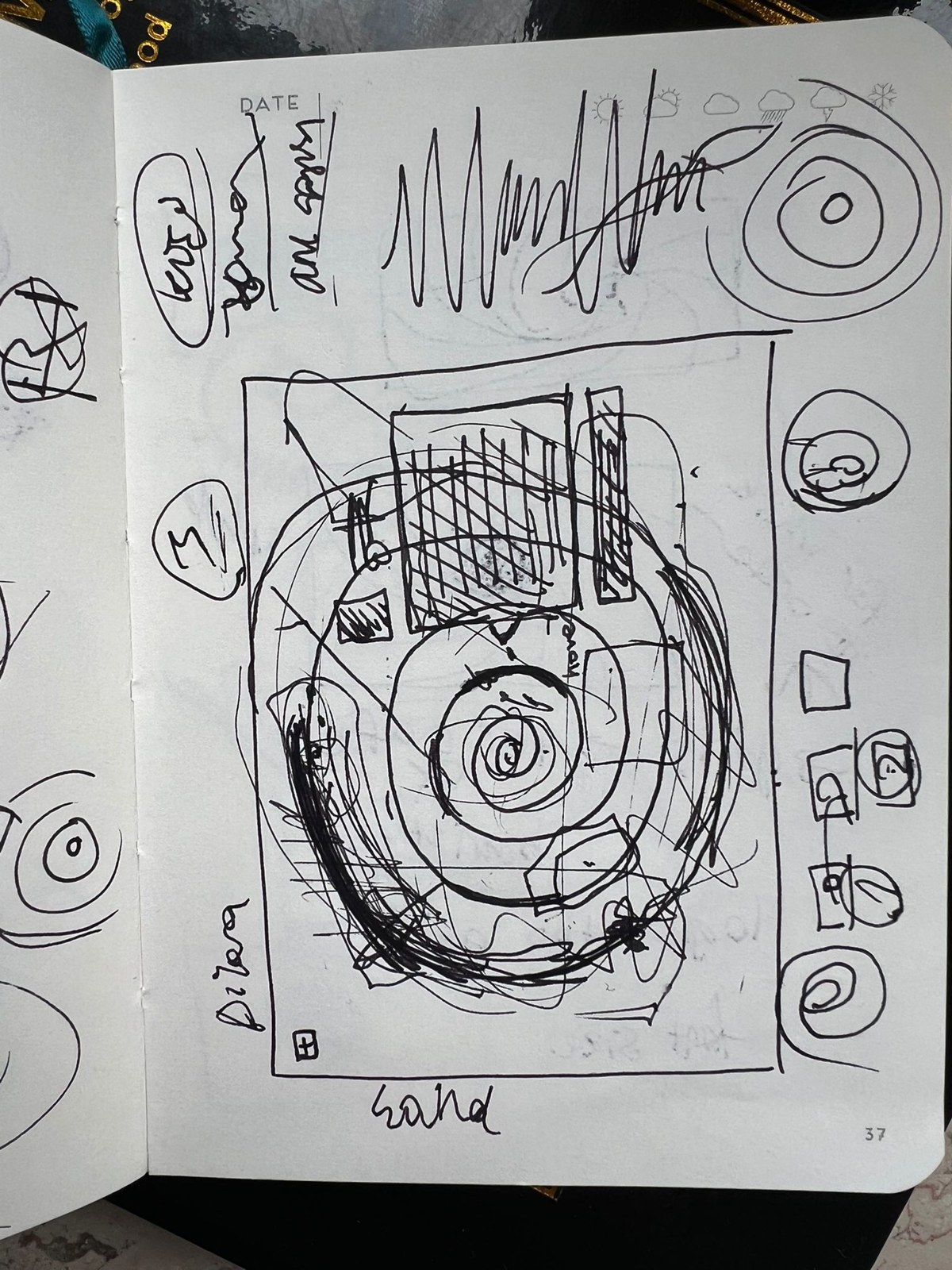
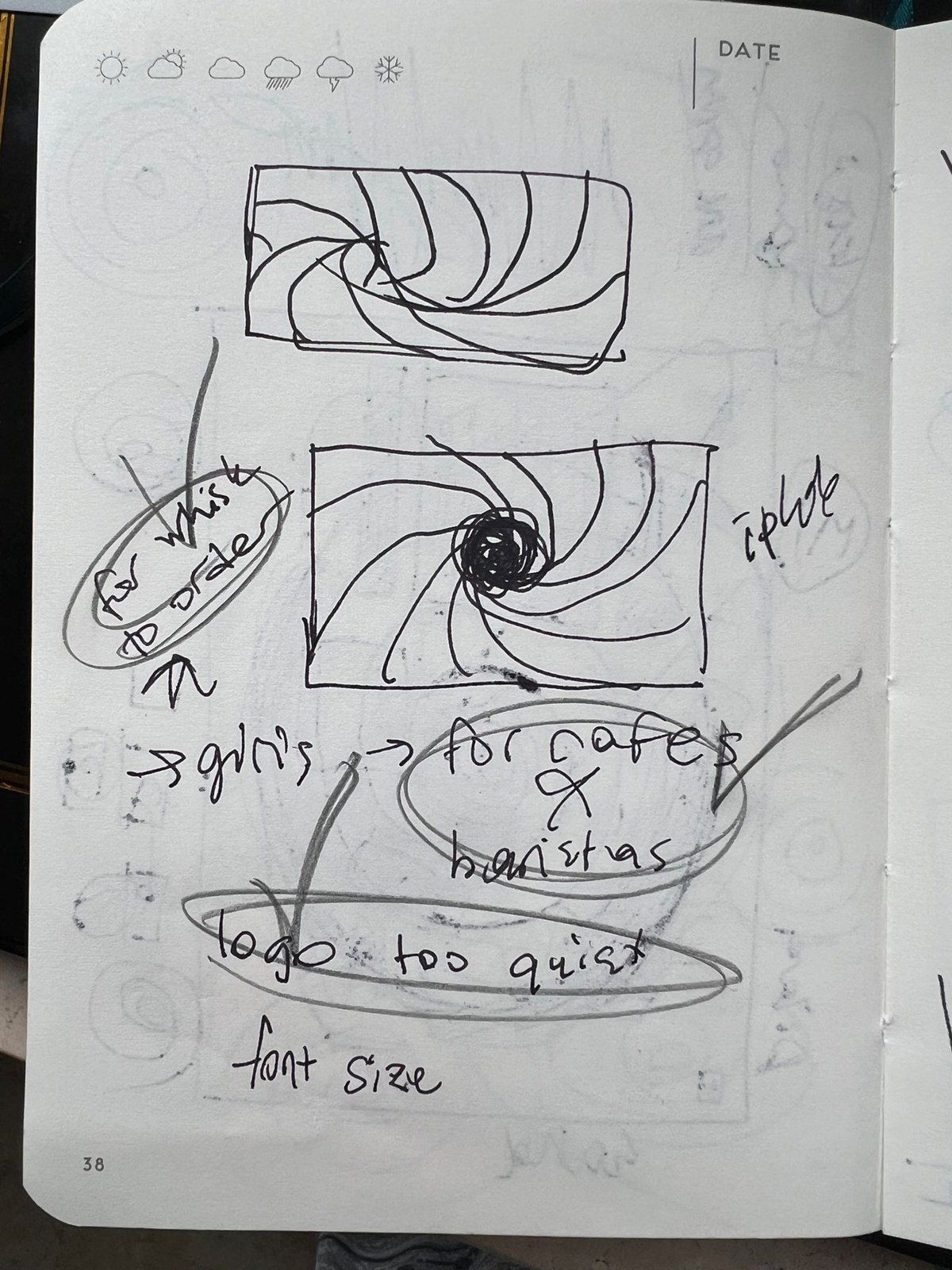
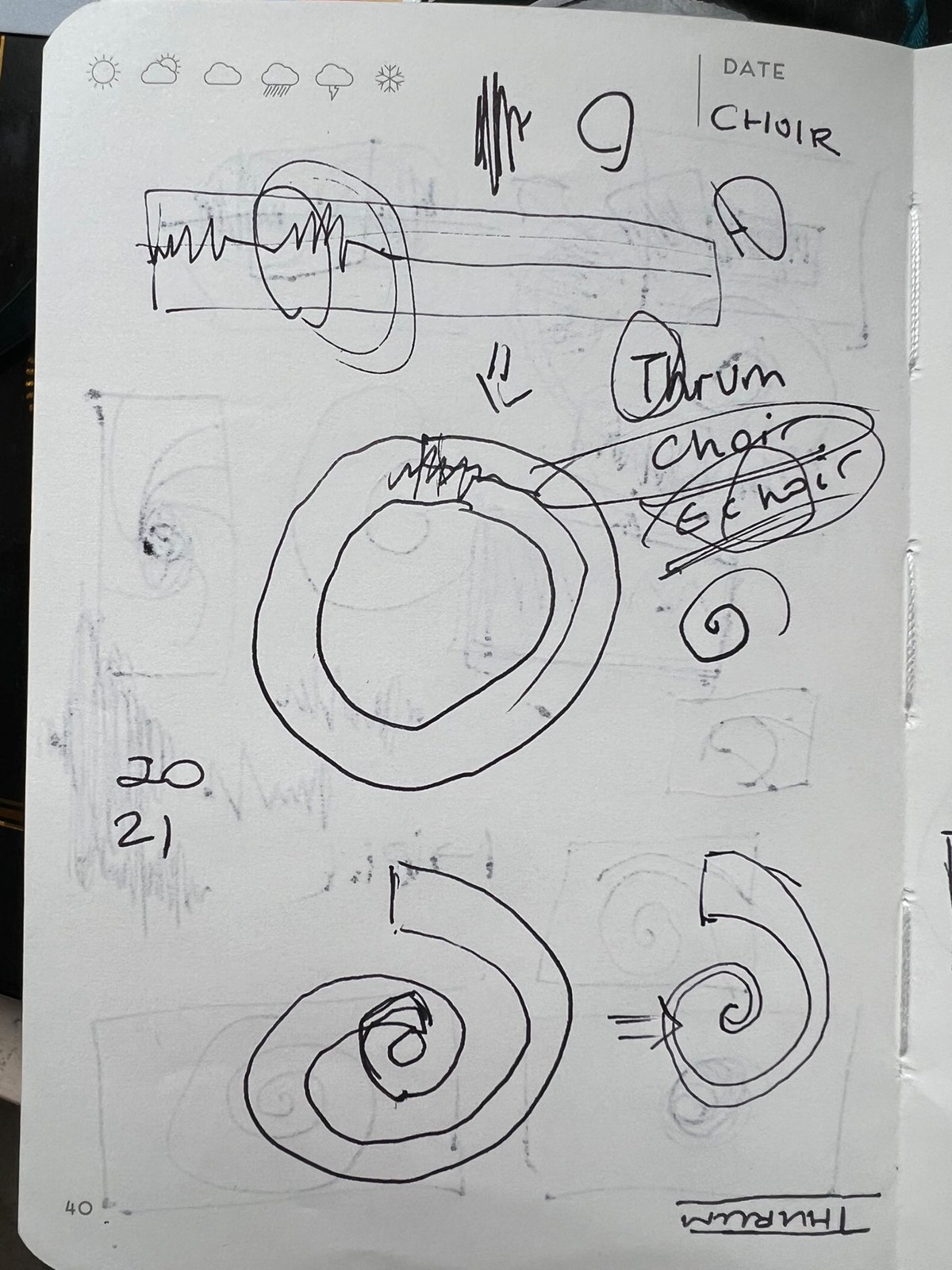
The spiral emerged through sketching, not as a starting point. Alongside it, names like Thrum, Choir and Echoir were tested until Chorale fit.

Sketchbook page working through the memorial page composition by hand Sketchbook page refining the spiral logo form, with notes on legibility Sketchbook page with waveform studies and naming exploration: Thrum, Choir, Echoir
Notebook pages: composition, spiral refinement, naming.

Wireframes

Wireframes worked out the logic: a code-gated entry, and a memorial page that holds both the shared spiral and one person's story, tested with real names and dates instead of placeholders.

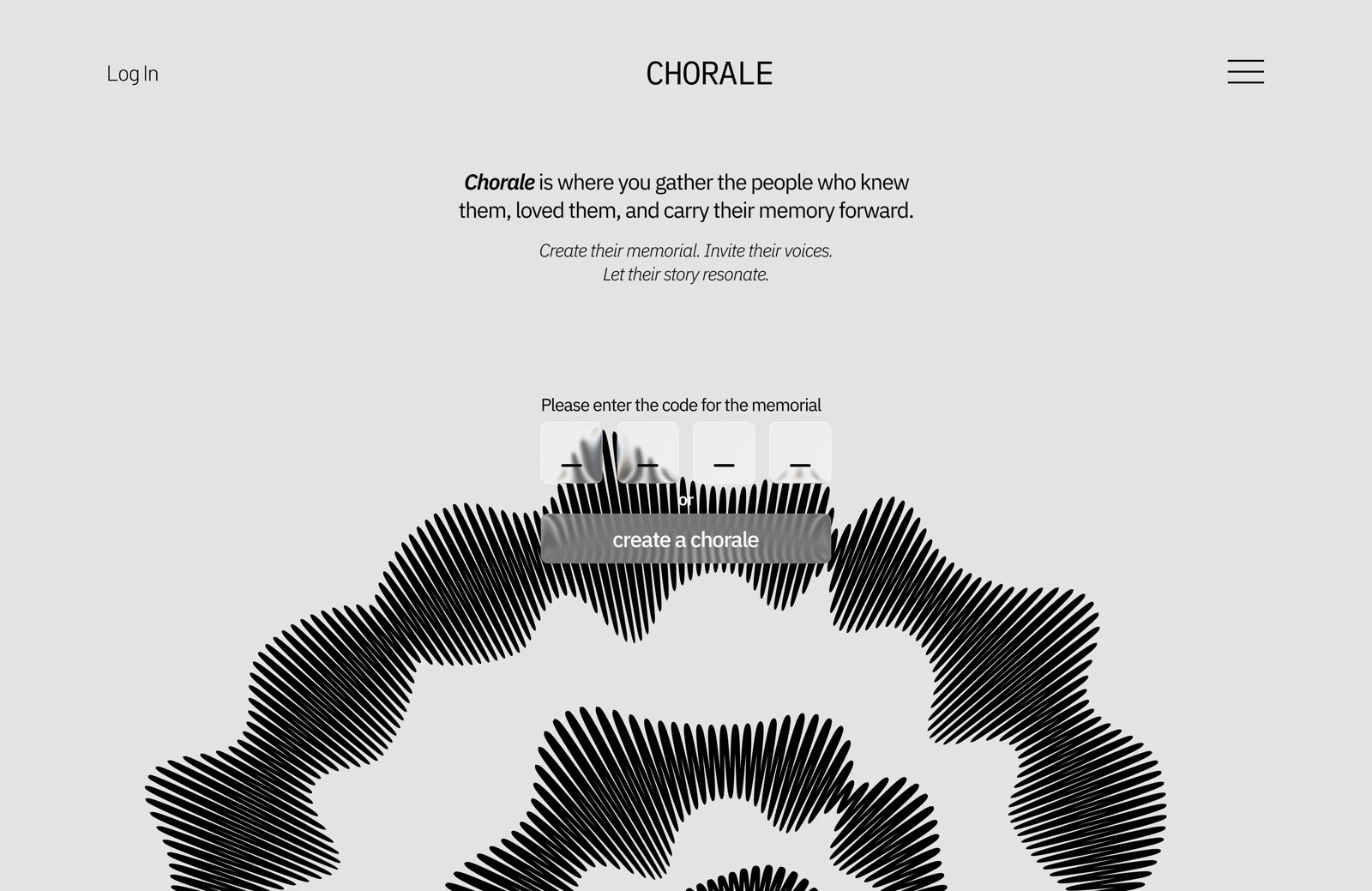
Wireframe of the entry screen: enter a memorial code or create a memorial

Entry: code-gated access

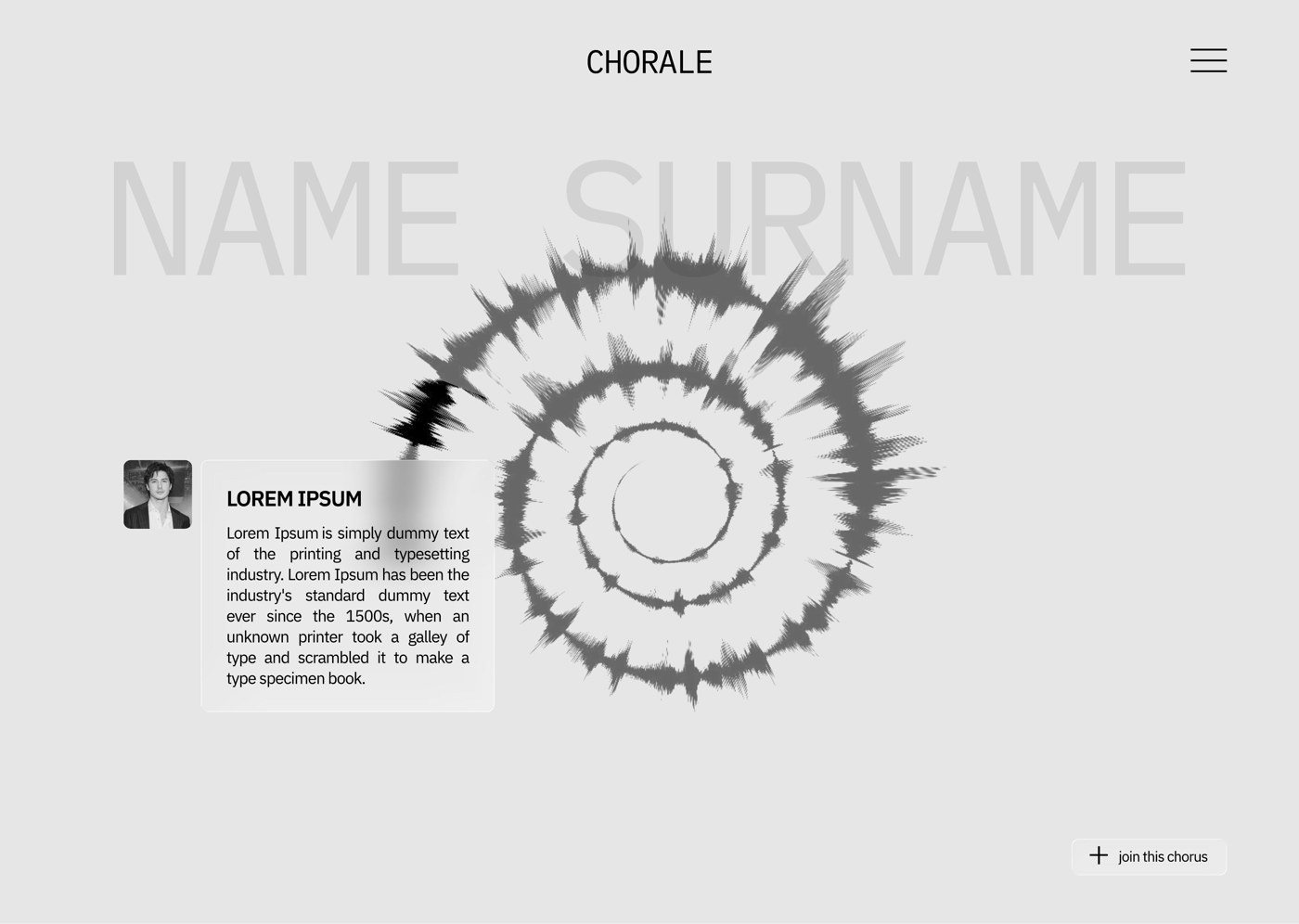
Wireframe of a generic memorial template with placeholder name and lorem ipsum content

Generic template

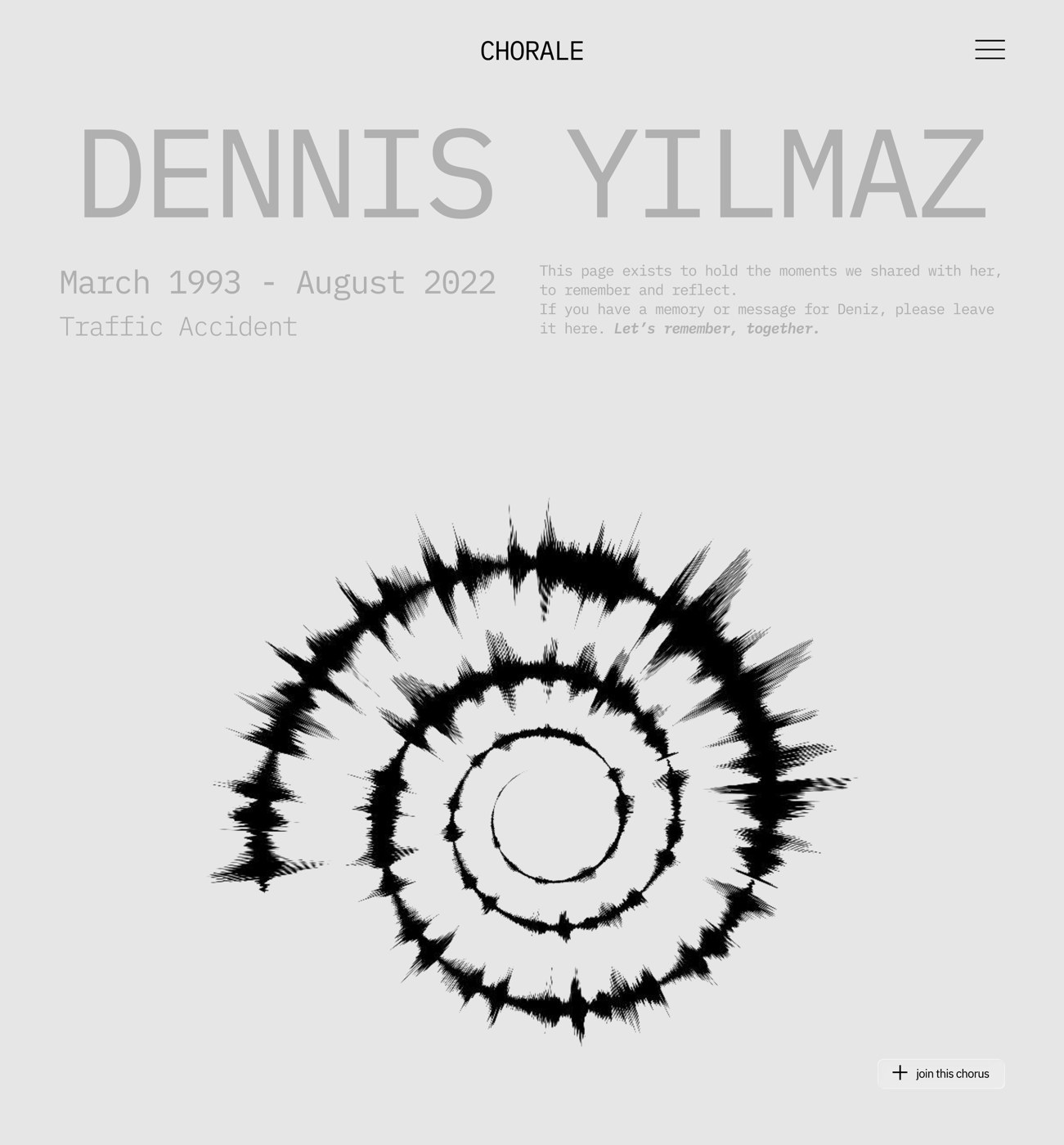
Wireframe of the Dennis Yilmaz memorial page populated with name, dates and cause

With a real memorial's details

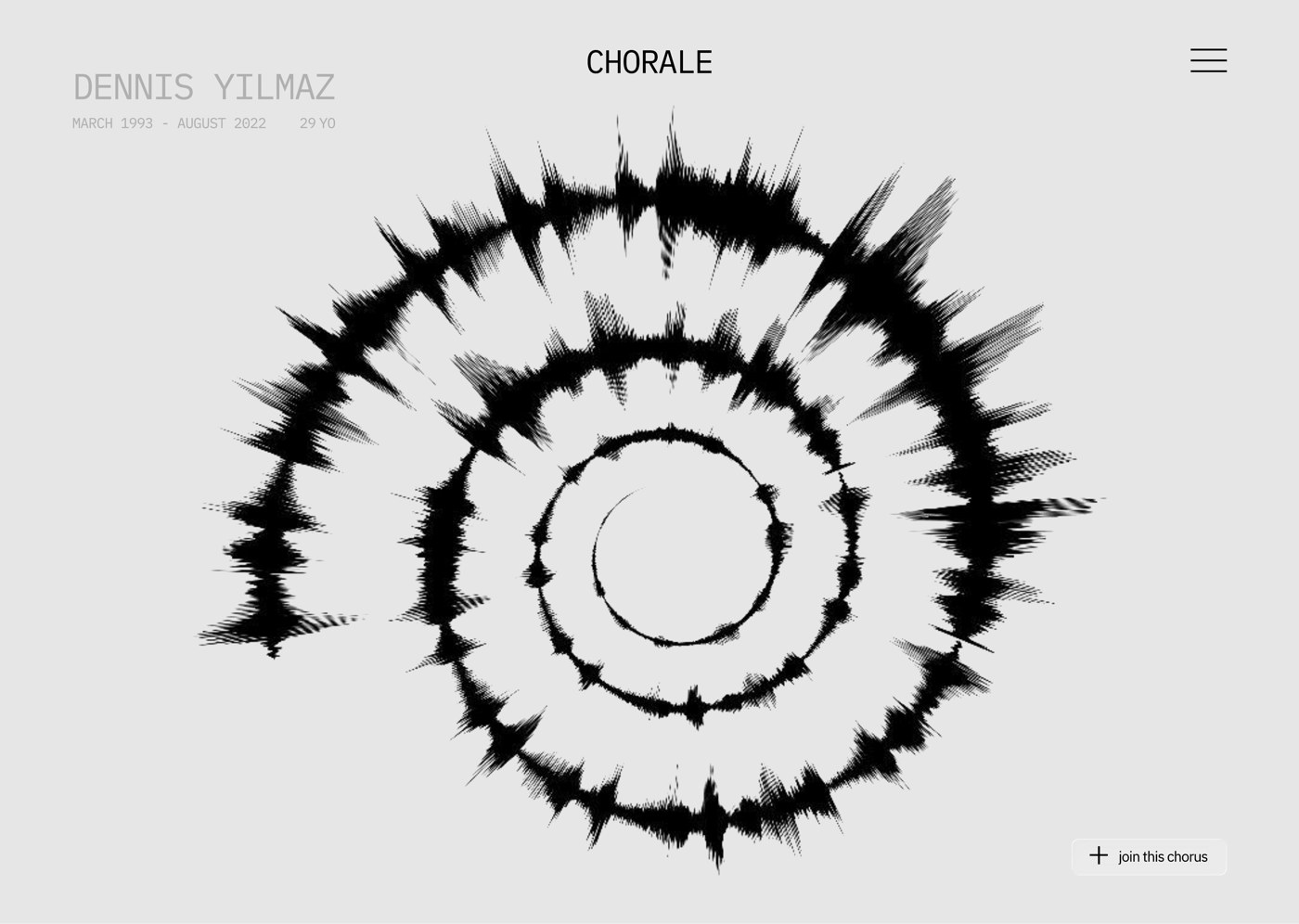
Wireframe of the refined memorial page header with age calculated from the dates

Refined header, age from dates

Product decisions

No likes, no comments, no AI replica: a co-created soundscape instead of a timeline. Three roles came out of the research, and people can move between them as their grief changes.

Caretaker

Opens the chorale and holds governance, as a relationship rather than an algorithm.

Existing platforms: governance is reactive or opaque

Contributor

Adds memories and chooses who sees each one.

50% prefer co-creating; 48% want private and shared

Observer

Takes part by listening and witnessing; nothing is required.

57% prefer passive viewing

Design principles

  1. Restraint as care

    No likes, comments or rankings. Less is protection.

    EvidenceSurvey: discomfort with performative visibility. Testing: removing metrics lowered the pressure people expected.

  2. Absence as structure

    The deceased is never represented or simulated.

    Evidence57% uncomfortable with a simulation; only 5% wanted to talk to the deceased.

  3. Resonance over representation

    Memory as accumulation and echo, not a fixed archive.

    Evidence61% keep a memory alive by talking with others. Continuing Bonds: connection, not closure.

  4. Proximity as agency

    Users choose how close they get.

    EvidenceNo consensus on privacy; 48% wanted a mix of private and shared.

  5. Participation without performance

    Silence counts. Nothing is ranked or required.

    EvidencePassive viewing (57%) was preferred over co-creating (50%).

  6. Governance as relationship

    Moderation is care held by caretakers, not enforcement.

    EvidenceExisting platforms: reactive or opaque governance. Testing: caretakers read as care, not control.

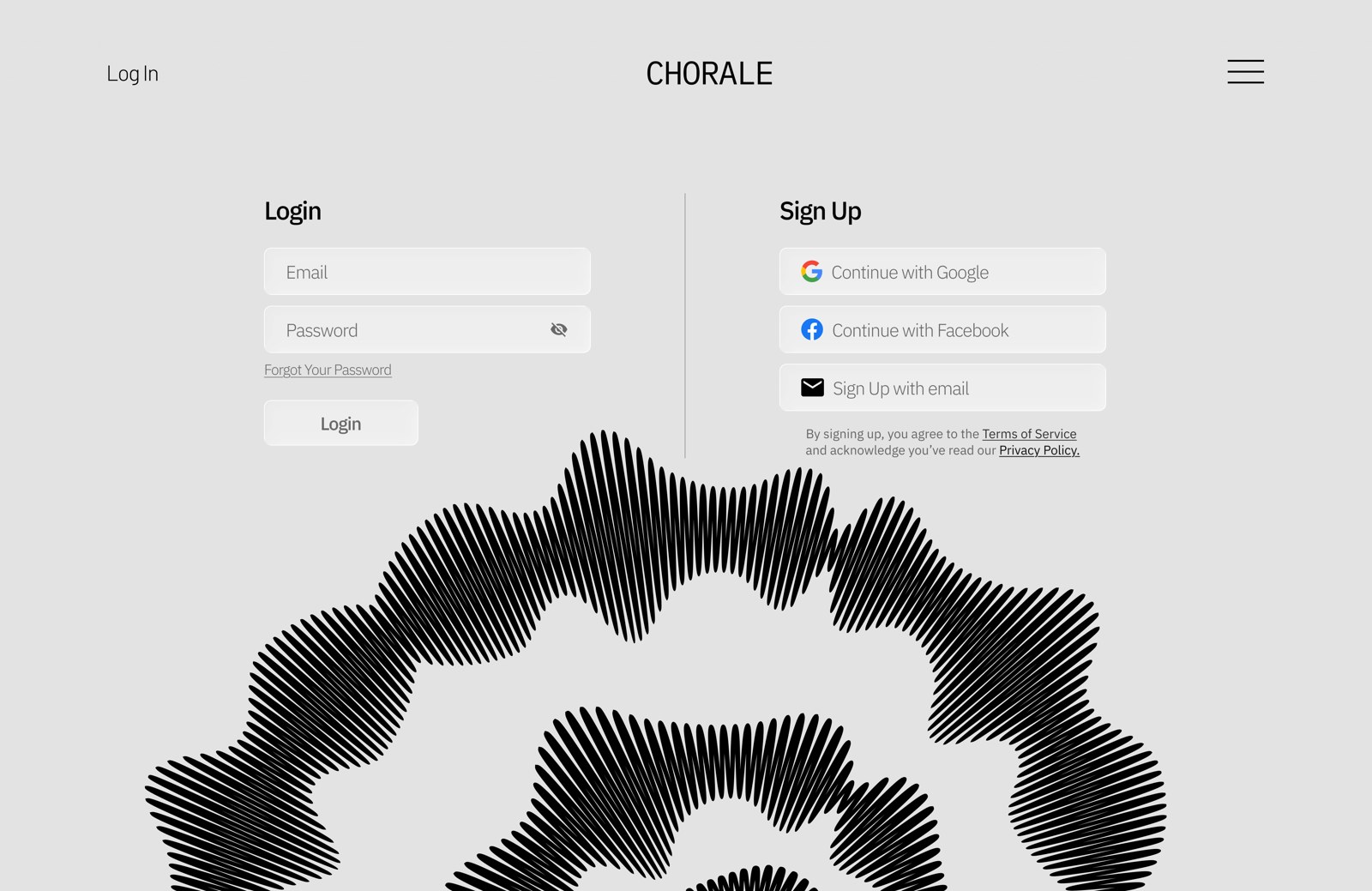
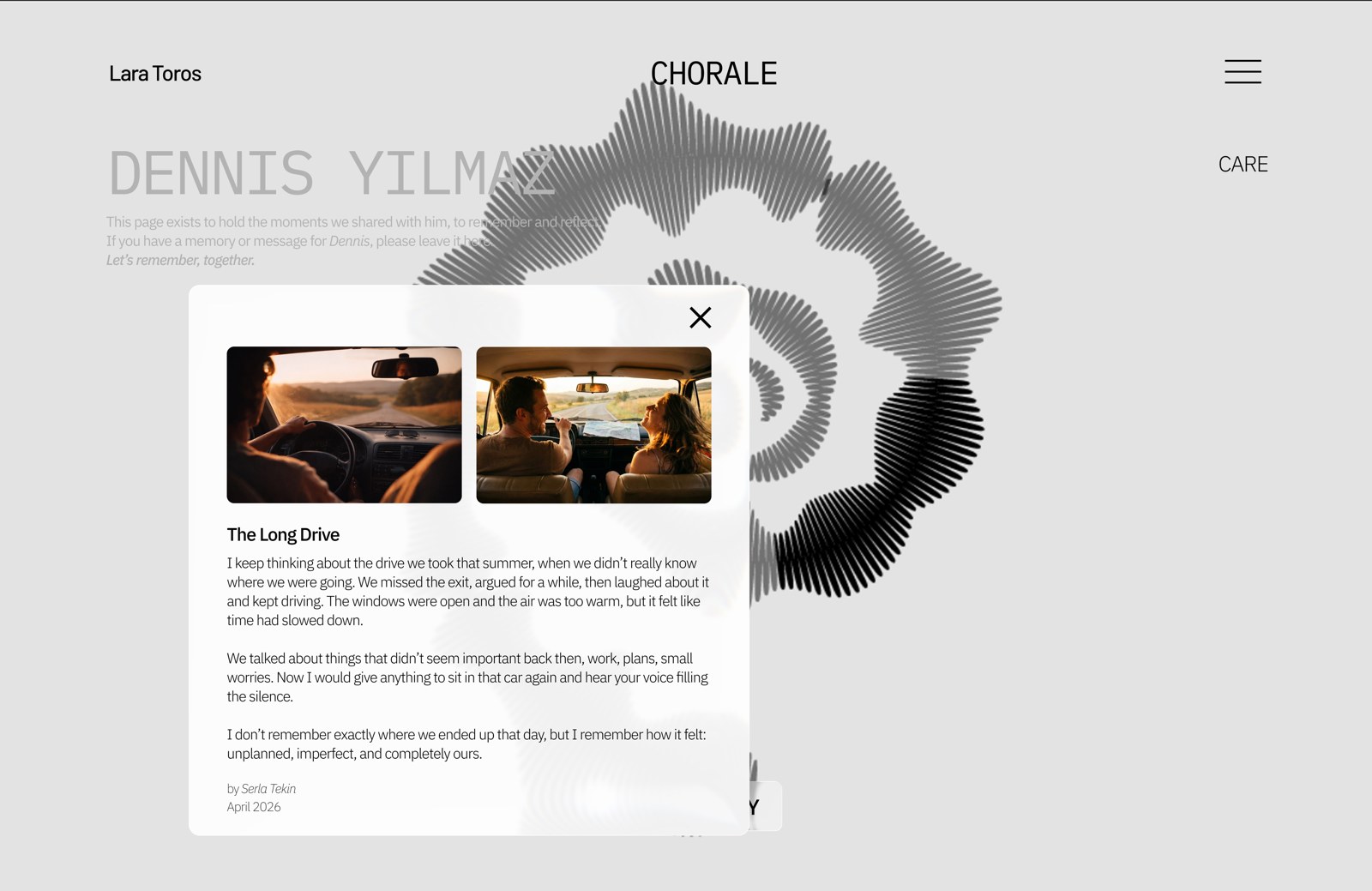
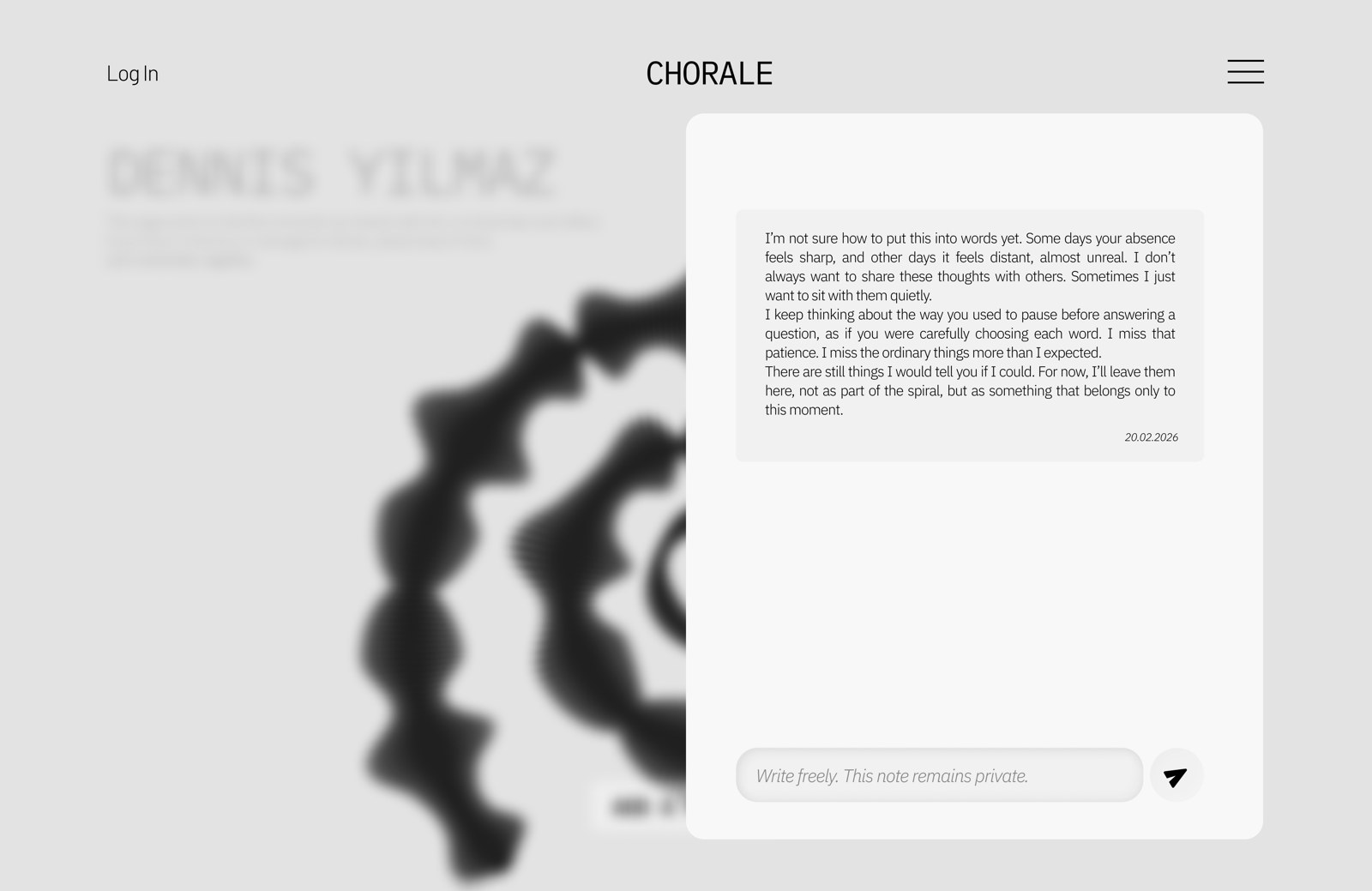
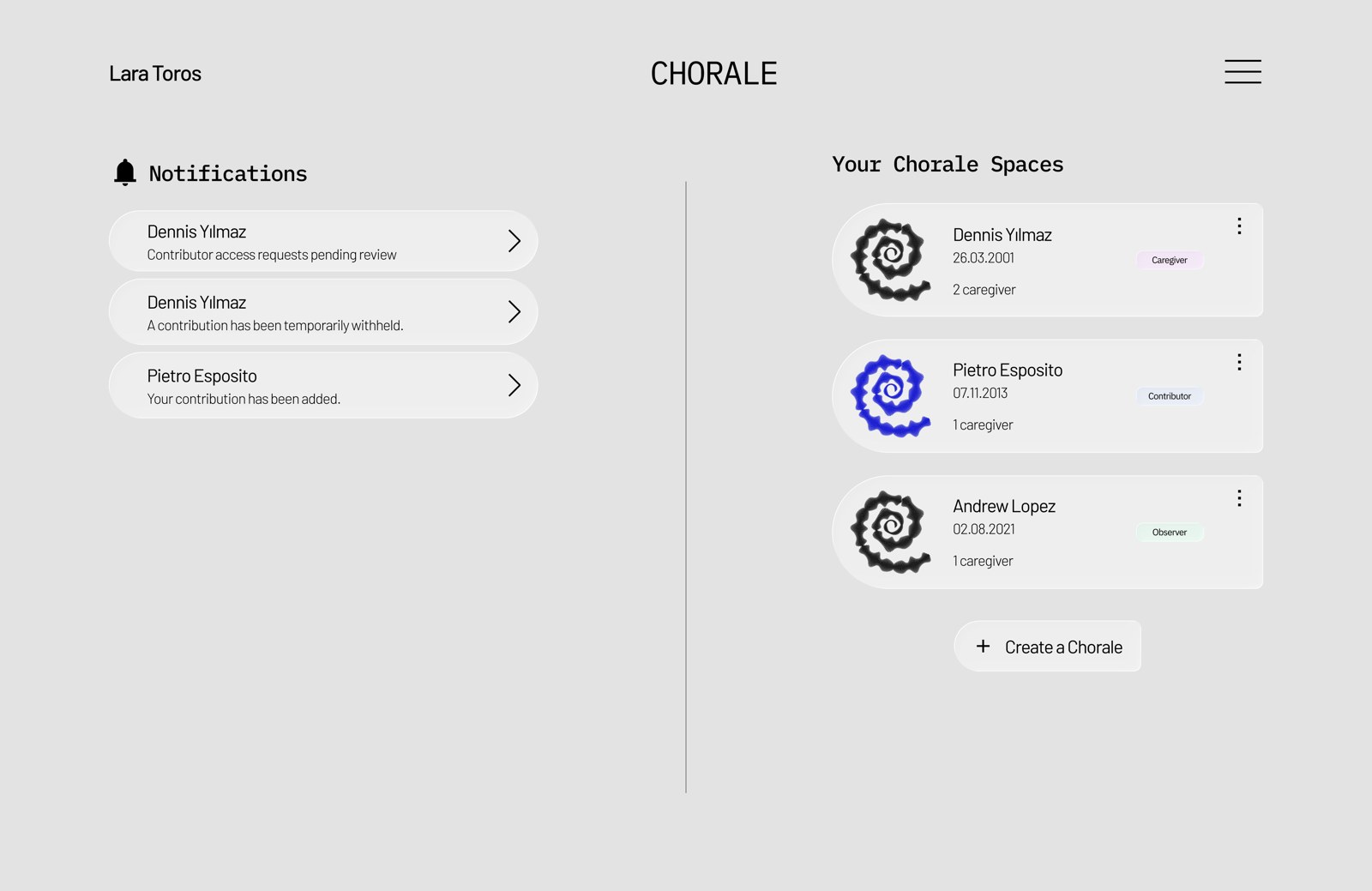
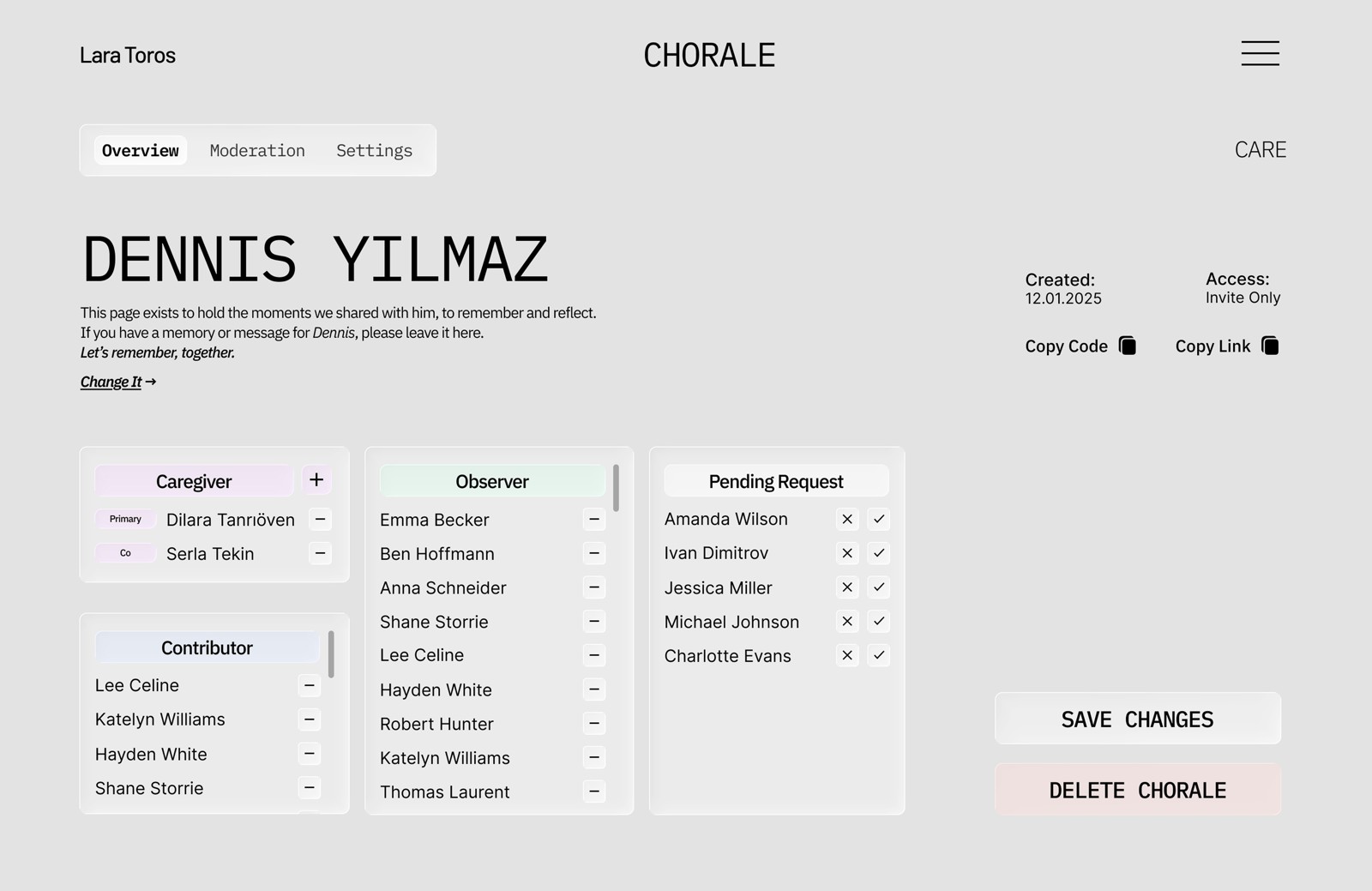
Final UI: entry screen with a code field and a create-a-memorial action Final UI: login and sign up screen Final UI: a contributed memory, The Long Drive, shown as a modal over the spiral Final UI: private quiet notes layer, not visible to others and not part of the shared spiral Final UI: notifications and a list of the user's Chorale spaces with their role on each Final UI: caretaker governance panel managing caregivers, contributors, observers and pending requests
Final prototype: entry, sign-in, a memory, private notes, dashboard, caretaker governance.

Testing it

6

participants

24–30

age range

3

task flows

Face-to-face, 20-minute task sessions (entry, creating a chorale, exploring and contributing), judged on usability, metaphor and ethical legibility, then SUS and UEQ. The spiral read as accumulation and removing metrics eased performative pressure. SUS was high; UEQ was positive on all six dimensions, with Novelty more varied, as a restrained interface would expect.

Friction did not emerge from complexity, but from the intersection of participation and governance.
  1. Ritual selection removed

    Symbols now come from contributions, not templates.

    EvidenceParticipants hesitated on these options; 51% of the survey was unsure about traditions.

  2. Quiet Notes and Care to be separated

    Private remembrance and governance shouldn't share a navigation level.

    EvidenceSeveral participants questioned why they sat side by side.

  3. Clearer caretaker permissions

    Stated where they apply, not explained afterwards.

    EvidenceTwo of six participants asked what the role could do.

  4. Save and delete in every Care section

    Not only on the final settings page.

    EvidenceDirect participant suggestion.

Limitations & what's next

Six participants aged 24–30 make the findings directional, and long-term governance across changing caretakers remains open. Next: a coded version with dynamic zoom and real-time sound, longitudinal studies, and cross-cultural testing.

Absence is not corrected. It is preserved.
Continuity emerges through contribution, not simulation.
Memory continues.